Grass pavers are supposed to lock together securely. When they do, the surface handles vehicle loads, stays flat, and allows grass to grow through the cells. When they don‘t, you get shifting pavers, uneven surfaces, and edges that catch tires or settle into mud.
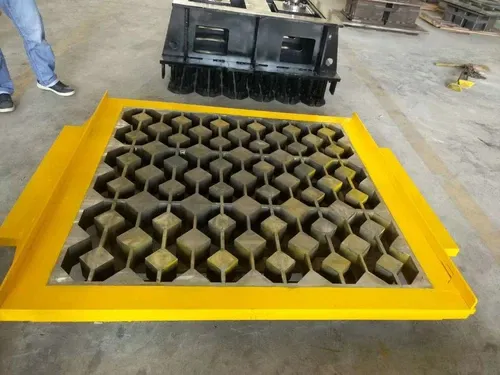
If your grass pavers aren’t locking properly, the problem usually starts with the mould. Here are the most common mould-related issues and how to fix them.
UNIK has been manufacturing grass paver moulds since 2008, with over 15 years of export experience to 28 countries. The fixes below come from actual field reports.
What happens – The raised knobs on top of the paver or the recesses underneath become rounded or shallow. Pavers sit on top of each other rather than locking in place. The surface shifts under traffic.
Why it happens – Interlocking features wear faster than the rest of the mould cavity because they are thinner and experience more friction during ejection. After 40,000-50,000 cycles on a standard steel mould, knob height can decrease by 0.3-0.5mm.
Fix – Measure knob height and recess depth with a depth gauge or calipers. Compare to the original mould drawing. If knob height has worn down by more than 0.3mm, the mould requires refurbishment. UNIK offers re-machining service to restore interlocking features to original specifications.
Prevention – Use a mould with proper heat treatment. Carburized moulds (HRC58-62 surface hardness) resist wear 2-3 times longer than untreated or quenched-only moulds.
What happens – Pavers from the same mould have inconsistent height. Some are taller on one side. The interlocking features don‘t align because the whole block is slightly twisted.
Why it happens – The mould‘s mounting plate has warped from uneven bolt tightening or from running on a machine with an uneven vibration table. Even 0.5mm of distortion across the plate creates measurable block twist.
Fix – Remove the mould from the machine. Place it on a known-flat surface (precision granite plate or thick float glass). Check for gaps with a feeler gauge. If distortion exceeds 0.3mm, the mould needs re-surfacing.
Prevention – Always tighten mounting bolts in a cross pattern using a torque wrench. Never run a mould on a machine with a damaged vibration table. Inspect the machine’s mounting surface annually.
Before assuming the mould is the problem, run this simple check:
Produce 10 pavers from the mould you suspect.
Clean any concrete dust or debris from the pavers.
Attempt to lock them together in a small test grid (3×3 or 4×4).
Observe which pavers fit and which don‘t.
Mark the cavity number on each paver (most moulds have cavity numbers embossed on the blocks).
If all loose pavers come from the same cavity, the problem is that specific cavity. If loose pavers come from random cavities, the issue may be machine-related or due to concrete mix changes.
UNIK provides cavity numbering on all multi-cavity grass paver moulds as a standard feature, making this diagnosis straightforward.
| Condition | Action |
| Knob height worn down 0.2-0.4mm | Refurbish (re-machine interlocking features) |
| Knob height worn down >0.5mm | Replace (insufficient material left for re-machining) |
| Cavity surface scratches or roughness | Re-polish |
| Worn core pins | Replace pins only |
| Cracked mould body | Replace |
| Distorted mounting plate (0.3-0.5mm) | Re-surface (machine flat) |
| Distorted mounting plate (>0.5mm) | Replace |
Problem: Pavers won‘t lock — knobs or recesses worn.
Fix: Refurbish mould or replace with properly heat-treated mould.
Problem: Some pavers lock, others don‘t — inconsistent cavities.
Fix: Professional re-machining of worn cavities.
Problem: Pavers stick during ejection — rough cavity surface.
Fix: Re-polish cavity to Ra 1.6 or better.
Problem: Open cells are misshapen — worn core pins.
Fix: Replace core pins.
Problem: Pavers deformed during ejection — insufficient draft angle.
Fix: Re-machine with 1.5-2.0 degree draft angle (not field-repairable).
Problem: Blocks twisted or uneven height — distorted mounting plate.
Fix: Re-surface mounting plate or replace mould.
If your grass paver mould has any of these issues and you need refurbishment or replacement:
Website: www.unikmould.com