News

How to Choose Between Steel and Plastic Moulds for Short-Run Projects?

2026-09-07 0 Leave me a message

For short-run concrete product projects, selecting the right mould type is a critical decision that affects both your upfront costs and project profitability. The choice between steel and plastic moulds involves evaluating production volume, budget constraints, and quality requirements. This guide provides a practical framework for making that decision.

How to Choose Between Steel and Plastic Moulds for Short-Run Projects?

Understanding the Trade-offs

Plastic Moulds: Low-Cost, Low-Volume Solutions

Plastic moulds for concrete products are manufactured from high-density polypropylene or similar industrial-grade materials. These are lightweight, affordable, and designed for shorter production runs.

Key Characteristics:

Lifespan: 300 to 600+ cycles, depending on model and usage conditions.

Cost: Typically US$1-3 per piece for basic models.

Weight: Significantly lighter than steel, reducing handling requirements.

Surface Finish: Good quality, suitable for most standard applications.

Compliance: PVOC-certified for streamlined import clearance in markets like Kenya.

When to Choose Plastic Moulds:

Project-based work where total production volume is under 500 units

Small-scale contractors or start-up operations

On-site casting where portability is important

Testing new product designs before committing to steel tooling

Budget constraints limiting upfront capital expenditure

Steel Moulds: High-Investment, Long-Term Solutions

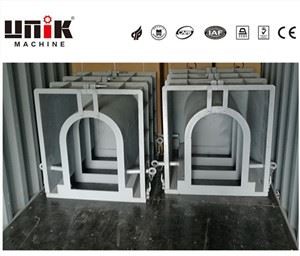
Steel moulds are precision-engineered from low-carbon alloy steel with advanced heat treatment. These are industrial-grade tools designed for high-volume production environments.

Key Characteristics:

Lifespan: 80,000 to 100,000+ cycles under normal production conditions.

Material: 42CrMo or Cr12MoV alloy tool steel.

Heat Treatment: Carburizing achieves surface hardness of HRC58-62 while maintaining core toughness at HRC35-40.

Precision: Single cavity dimensional tolerances of ±0.1mm and surface finishes of Ra 1.6 or better.

Cost: US$8,000+ for industrial steel sets.

When to Choose Steel Moulds:

Brick plants and large contractors running daily production shifts

Long-term projects requiring consistent quality across thousands of units

Production environments with abrasive concrete mixes (sharp sand, recycled aggregates)

Operations where downtime for mould replacement is costly

How to Choose Between Steel and Plastic Moulds for Short-Run Projects?

Short-Run Project Considerations

The "Tipping Point" Analysis

There is a clear economic "tipping point" where investing in a steel mould becomes more cost-effective than repeatedly purchasing plastic moulds. While a steel mould requires higher upfront investment, its cost per unit dramatically decreases as production volume increases.

Production Volume Recommended Mould Type Rationale
Under 500 cycles Plastic Lowest upfront cost; plastic moulds are sufficient for this range
500-1,500 cycles Consider plastic with potential upgrade Evaluate if volume justifies steel investment
Above 1,500 cycles Steel Lower cost per unit over mould lifespan
Daily production Steel Durability, consistency, and long-term economics

Project-Based Flexibility

For contractors working on multiple short-term projects, a combination approach may be optimal. Purchasing steel moulds for core, high-volume products and plastic moulds for low-volume or experimental designs can balance cost and capability.

Quality and Performance Comparison

Dimensional Accuracy

Steel moulds offer superior dimensional consistency due to precision CNC machining and stable material properties under production conditions. Cavity dimensions are maintained at ±0.1mm tolerance. Plastic moulds, while adequate for many applications, may show greater dimensional variation over their lifespan.

Surface Finish

Steel moulds achieve surface finishes of Ra 1.6 or better, resulting in smoother concrete products and easier demoulding. This is particularly important for decorative or architectural applications where surface appearance matters.

Durability Under Abrasion

Steel moulds with proper heat treatment maintain surface hardness of HRC58-62, resisting wear from sharp aggregates and recycled materials. Plastic moulds, by contrast, will show accelerated wear with abrasive mixes.

Application-Specific Recommendations

Standard Concrete Mixes

For projects using standard concrete mixes with virgin aggregates, both plastic and steel moulds can produce acceptable quality. The decision primarily depends on volume and budget.

Abrasive Mixes

When using sharp sand, recycled aggregates, or decorative aggregates, steel moulds are strongly recommended. The superior wear resistance prevents premature surface degradation that would render plastic moulds ineffective after fewer cycles.

Complex Interlocking Shapes

For pavers or blocks with intricate interlocking profiles, steel moulds offer the precision needed to maintain geometry across thousands of cycles. Plastic moulds may not hold tight tolerances over extended production runs.

How to Choose Between Steel and Plastic Moulds for Short-Run Projects?

Summary Decision Matrix

Factor Choose Plastic Choose Steel
Production Volume Below 500 units Above 1,500 units
Budget Limited upfront capital Available for long-term investment
Concrete Mix Standard Abrasive (sharp sand, recycled)
Product Complexity Simple shapes Complex interlocking or architectural profiles
Project Type One-off or short-term Ongoing production or infrastructure
Reusability Single project Multiple projects over years

Conclusion

The choice between steel and plastic moulds for short-run projects is fundamentally an economic calculation based on production volume and quality requirements. For runs under 500 units, plastic moulds offer a cost-effective solution. For operations approaching 1,500 units or more, the investment in steel moulds delivers lower cost per unit and consistent quality. The growing availability of factory-direct pricing from Chinese manufacturers, such as UNIK's direct factory pricing with no middleman markup, makes steel moulds more accessible for a wider range of project scales.

How to Choose Between Steel and Plastic Moulds for Short-Run Projects?

Related News
Leave me a message
X
We use cookies to offer you a better browsing experience, analyze site traffic and personalize content. By using this site, you agree to our use of cookies.Privacy Policy
RejectAccept