News

Uneven Thickness on Hexagonal Pavers? Check These Three Mold Design Flaws First

2026-06-08 0 Leave me a message

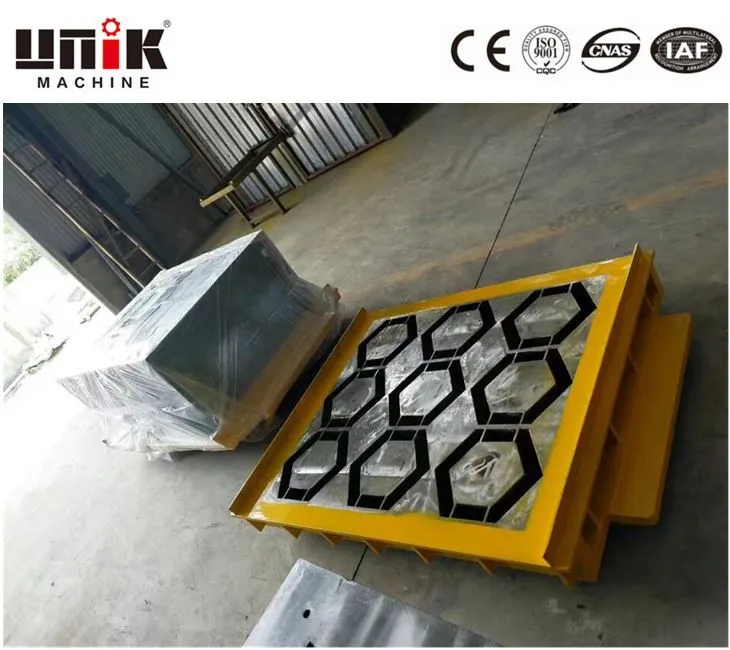
Hexagonal pavers are widely used for erosion control, grass parking, and landscaping projects. Their six-sided geometry demands precise mold design. When thickness varies across the paver — one edge thicker than the opposite edge, or the center thinner than the perimeter — the problem is rarely the concrete mix or the machine. More often, the mold itself is the root cause.

This article examines three common mold design flaws that produce uneven hexagonal pavers. Each flaw has a specific fix. Addressing these issues can reduce waste, improve block consistency, and extend mold life.

Flaw No. 1: Uneven Cavity Wall Wear

The Problem

In a hexagonal paver mold, concrete enters the cavity from the bottom and flows toward the walls. The walls that face the concrete flow direction wear faster than the opposite walls. Over thousands of cycles, one side of the cavity becomes thinner than the other. The paver then comes out with one edge thicker than the opposing edge.

This type of uneven thickness is directional. It shows up as a wedge shape rather than a symmetrical hexagon. Operators often blame the machine's vibration or the concrete mix, but the real cause is uneven wear on the cavity walls.

The Fix

Mold designers can account for material flow by adding extra thickness to high-wear walls or by using a harder steel grade on those surfaces. At UNIK, we use carburizing heat treatment to harden all cavity walls uniformly to HRC58-62. The hard surface resists abrasion, and the treatment depth (approximately 2mm) provides a consistent wear layer across every wall of the hexagon. This slows down differential wear and maintains cavity geometry longer.

Flaw No. 2: Sharp Internal Corners

The Problem

A hexagonal cavity has twelve internal corners — six at the top edge and six at the bottom edge. When these corners are machined as sharp 90-degree angles, they become stress concentration points. Each vibration cycle pushes stress into these sharp corners. The metal at the corner deforms slightly, then recovers. Over tens of thousands of cycles, this repeated stress causes the cavity to distort. The distortion changes the distance between opposing walls, resulting in pavers that are thicker on one side and thinner on another.

Sharp corners also wear faster than radiused corners. A sharp corner has less metal mass to absorb impact. Once the corner rounds off from wear, the cavity shape changes permanently.

The Fix

Adding a radius to every internal corner eliminates stress concentration points. A 3–5mm radius allows stress to flow around the corner rather than crashing into it. The cavity retains its shape longer, and the paver thickness remains consistent across all six sides.

Radiused corners also improve demolding. Concrete releases more cleanly from a curved surface than from a sharp edge, reducing drag and further slowing wear.

Flaw No. 3: Uneven Cavity Depth Across the Mold Plate

The Problem

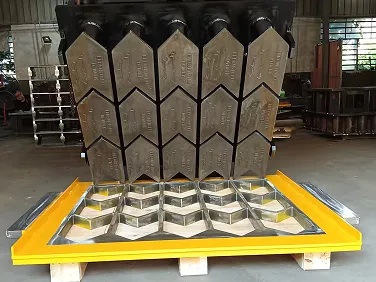
A hexagonal paver mold typically contains multiple cavities — two, three, or four per mold plate. When the mold plate itself is not perfectly flat or when the cavities are machined to different depths, each cavity produces a paver of different thickness. This variation is not directional (like flaw No. 1). It is positional: cavity one produces thick pavers, cavity three produces thin pavers.

The root cause is often poor machining or an uneven base plate. Low-cost suppliers may skip the step of flattening the mold plate before cutting cavities. Others use worn CNC tools that cut deeper on one side of the plate than the other. The result is inconsistent paver thickness from the same mold.

The Fix

Each mold plate must be surface-ground flat before any cavity is machined. Dimensional tolerance should be held to ±0.1mm across the entire plate. Cavity depth must be checked at multiple points — center and edges — for every cavity.

At UNIK, we use CNC machining with in-process inspection. Each cavity depth is verified during cutting. After machining, the full mold plate is measured on a coordinate measuring machine (CMM) to confirm that all cavities are within tolerance. Any variation beyond ±0.1mm triggers a rework.

How to Diagnose Which Flaw Is Affecting Your Production


Symptom

Likely Flaw

Verification Method

Pavers show a wedge shape (one edge thicker than the opposite edge)

Flaw No. 1 — Uneven cavity wall wear

Measure cavity wall thickness at multiple points

Pavers have inconsistent thickness across cavities (cavity 1 vs. cavity 3)

Flaw No. 3 — Uneven cavity depth

Check depth of each cavity on the mold plate

Pavers show localized thin spots near corners

Flaw No. 2 — Sharp internal corners

Inspect cavity corners for radius or sharpness

All pavers from all cavities are consistently uneven in the same pattern

Flaw No. 3 — Uneven base plate

Check mold plate flatness with a straight edge


Prevention Through Proper Mold Design

Uneven thickness on hexagonal pavers is not inevitable. Three design practices prevent the majority of thickness variation problems:

1.Use carburizing heat treatment to create uniform surface hardness (HRC58-62) across all cavity walls, slowing differential wear.

2.Machine 3–5mm radii on all internal corners to eliminate stress concentration and distortion.

3.Hold ±0.1mm tolerance on cavity depth and plate flatness, verified by CMM inspection.

UNIK has applied these practices since its founding in 2010. Based in Quanzhou, China, the company manufactures brick machines and concrete molds for 28 countries. Its product line includes hexagonal paver molds, curb molds, block molds, and hollow block tooling.

For hexagonal paver molds that produce consistent thickness cycle after cycle, specifications include 42CrMo steel, carburizing heat treatment, 3–5mm corner radii, Ra 1.6 surface finish, and ±0.1mm dimensional tolerance.

Fujian Unik Mould Technology Co., Ltd.

Website: www.unikmould.com


Related News
Leave me a message
X
We use cookies to offer you a better browsing experience, analyze site traffic and personalize content. By using this site, you agree to our use of cookies. Privacy Policy
Reject Accept